
Kubwa News
2025: Could this be the End of Mai-bola in Kubwa?


Waste management and disposal have been a long-time challenge in Kubwa and indeed the whole Bwari Area Council. Residents have felt helpless and overwhelmed for the longest time when it comes to disposing of their solid waste and other types of waste safely.
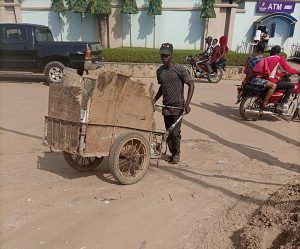
Daily Trust 2024
The management of Bwari Area Council, it appears, has since concluded an arrangement with a “Technical Partner” to handle matters related to waste management in the Area Council and put a structure and a sense of order in waste collection and disposal. With this arrangement, it seems we may just be seeing the end of Mai-bola and their unregulated services as waste collectors.
Mai-bola, also known as Baban-bola, are young refuse collectors who have a mixed reputation; their only good part being that they provide convenience for individuals whose domestic waste needs to be evacuated. On the flip side, the bola boys constitute the greatest threat to environmental health and safety, apart from cases of thievery and vandalism. They have no concept of health and environmental protection.
The waste they are paid to collect from homes ends up in nearby rivers and water channels around the town of Kubwa. This reckless practice has effectively destroyed our freshwater habitat and contributed to the blockage of water channels and, in some cases, flooding. Notable spots for this environmental pollution include the Phase 4 bridge, PW bridge by Deeper Life Church, Mama Charlie Junction, also in PW and the bridge by the expressway just after Phase 3 Junction. Curiously, residents of some communities whose management prohibits the entrance of mai-bola due to security considerations seem to “collaborate” with them to create unapproved dumpsites around town to heap up refuse, and this has been nothing but an eyesore, to say the least. The mismanagement of waste in Kubwa has been nothing short of a menace due to the potential of this situation leading to an outbreak of waterborne diseases and infections.
Only a few residents can deny complicity in this damaging activity.
The above and other considerations may be the reasons for the management of Bwari Area Council to take action to forestall a likely epidemic.
The waste they are paid to collect from homes ends up in nearby rivers and water channels around the town of Kubwa. This reckless practice has effectively destroyed our freshwater habitat and contributed to the blockage of water channels and, in some cases, flooding.
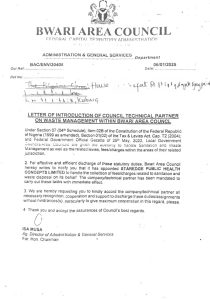
In a letter of introduction currently being circulated to homes within Kubwa, the management introduces STARGATE PUBLIC HEALTH CONCEPT LIMITED as their technical partner, with the mandate “to handle the collection of fees/charges related to sanitation and
waste disposal on its behalf”. The letter signed by Mr Isa Musa Acting Director of Administration and General Services, on behalf of the Bwari Area Council chairman, went further to add that the “company/technical partner has been mandated to carry out these tasks with immediate effect”.
This letter, as expected, is already generating mixed reactions among residents, many of whom welcome the idea of an officially coordinated waste collection and disposal arrangement. They, however, complain that there was no prior information and sensitisation of residents regarding this arrangement. Also, the content of the letter seems ambiguous as it does not succinctly address the mode of waste collection to be adopted by the service provider; rather, it emphasises more on the collection of fees for a yet-to-be adopted waste disposal service. Furthermore, when asked about how much the fee will be, the dispatch lady who would prefer not to be identified, stated that the fee schedule will be published in due course. This also got the inquiring residents wondering if this is the best approach to the introduction of a new but vital service.
According to a 2013 survey, an average household in Abuja can generate up to 0.95kg of solid waste daily, which is just under 1kg. The waste is mostly organic or food waste, plastic (mostly shopping bags), paper, metal (such as damaged home appliances), glass, and textiles. Other types of waste include packing materials used for delivering home appliances, some of which can be of such a big size and thickness.
It is also noted that households generate waste based on their level of income. Where middle-income earners tend to generate more waste, those who fare poorly generate less domestic waste. This notwithstanding, the observable fact is that the population who are assumed to be poor dispose of their waste in an indiscriminate manner. Examples abound in communities around Kubwa village where solid waste is dumped in gutters and roadsides, creating an ever-untidy outlook to the environment.
It is hoped that this new waste management partnership arrangement will be acceptable and affordable for residents, and that they will fully cooperate with the government to keep Kubwa and indeed everywhere in Bwari Area Council.



-
 Kubwa News5 months ago
KUBWA ARAB ROAD LIKE YOU’VE NEVER SEEN BEFORE!
-

 Politics7 months ago
BWARI AREA COUNCIL ELECTION SERIES: HON. SOLOMON DANJUMA GARDA
-

 Business5 months ago
THE OBJECT CALLED WOMAN
-

 Entertainment7 months ago
Mind Your Mind
-

 Politics7 months ago
BWARI AREA COUNCIL ELECTION SERIES: HON. JOSIAH MUSA KOCHE
-
 FCT News8 months ago
WATER DISRUPTION UPDATE
-
FCT News8 months ago
FCT WATER BOARD EXCLUSIVE! WHY YOU ARE NOT BILLED
-

 Fashion8 months ago
Happy Birthday to one of Kubwa’s finest nail artists – Mrs Oge U. Ekenna
Pingback: In Defence of Kubwa and Her Environment - Inside Kubwa