
Politics
Wike, Tinubu and the PDP: Nigeria’s 2027 Political Contradiction

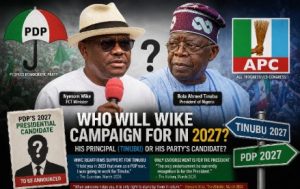
As Nigeria gradually inches toward the 2027 general elections, one political question continues to generate confusion, debate, and no small amount of irony across the country.
How does a leading figure of the opposition People’s Democratic Party simultaneously serve as one of the most visible defenders of the ruling All Progressives Congress government?
At the centre of this unfolding political puzzle is Nyesom Wike, the Minister of the Federal Capital Territory and former governor of Rivers State.
Wike remains officially a member of the PDP. Yet he has repeatedly and publicly reaffirmed his support for President Bola Ahmed Tinubu and his expected re election bid in 2027.
In March 2026, Wike openly declared that he would again support Tinubu in the next election cycle. According to The Guardian, the minister said:
“I told you in 2023 that even as a PDP man, I was going to work for Tinubu.”
The Guardian report on Wike affirming support for Tinubu in 2027
In another report published by The Nation, Wike insisted that “the only endorsement he currently recognises is for the President.”
The Nation report on Wike reaffirming support for Tinubu
Yet, despite his closeness to the Tinubu administration, the PDP faction aligned with Wike has continued preparations for the 2027 elections.
According to a report by TheCable, the Wike backed PDP faction screened Sandy Onor as its sole presidential aspirant ahead of the party’s presidential primary election scheduled for May 26, 2026.
TheCable report on Wike-led PDP faction screening Sandy Onor as sole presidential aspirant
Speaking after the screening exercise, Sandy Onor reportedly defended Tinubu’s removal of fuel subsidy, saying:
“Nigerians universally agreed that subsidy was a problem and a bastion of corruption.”
He added:
“This president came on his very first day in office, removed the subsidy and released a lot of funds for development.”
That development has now deepened the political contradiction many Nigerians are struggling to understand.

Sandy Onor
If Sandy Onor eventually emerges as the PDP presidential candidate against Tinubu, where exactly will Wike stand?
Will he mount campaign stages across the country asking Nigerians to re elect President Tinubu, the same man under whom he currently serves as minister?
Or will he suddenly return to full opposition politics and campaign for Sandy Onor, the candidate produced by the same PDP faction associated with him?
The confusion is further heightened by Wike’s own comments about loyalty and political gratitude. In an interview reported by The Whistler, the minister justified his support for Tinubu by saying:
“When someone helps you, it is only right to stand by them in return.”
The Whistler report on why Wike says he will still support Tinubu in 2027
That statement alone appears to leave little doubt about where his personal political commitment lies.
Yet the PDP has neither fully disowned him nor successfully detached his political structure from the party. Instead, the uneasy coexistence continues, with Wike remaining one of the most influential voices connected to the opposition while openly identifying with the ruling government.
For critics, the situation represents a collapse of ideological politics in Nigeria. Political parties, they argue, increasingly function as temporary alliances of convenience rather than institutions built on shared principles or consistent policy positions.
For supporters of Wike, however, politics is ultimately about interests, negotiation, and strategic relationships. They argue that cross party alliances are not new in Nigeria and that Wike is simply exercising political pragmatism.
Still, the bigger question remains unanswered.
Can a man serve as one of the loudest advocates of a ruling government while simultaneously retaining influence within the opposition seeking to unseat that same government?
Nigeria may eventually provide the answer in 2027.
Until then, the contradiction remains one of the most fascinating political riddles in the country today.




-
 Kubwa News5 months ago
KUBWA ARAB ROAD LIKE YOU’VE NEVER SEEN BEFORE!
-
 Politics7 months ago
BWARI AREA COUNCIL ELECTION SERIES: HON. SOLOMON DANJUMA GARDA
-

 Business5 months ago
THE OBJECT CALLED WOMAN
-

 Entertainment7 months ago
Mind Your Mind
-
 Politics7 months ago
BWARI AREA COUNCIL ELECTION SERIES: HON. JOSIAH MUSA KOCHE
-
 FCT News8 months ago
WATER DISRUPTION UPDATE
-
FCT News8 months ago
FCT WATER BOARD EXCLUSIVE! WHY YOU ARE NOT BILLED
-
 Fashion8 months ago
Happy Birthday to one of Kubwa’s finest nail artists – Mrs Oge U. Ekenna