News
Claim Your Voice: Registration Deadline is Close

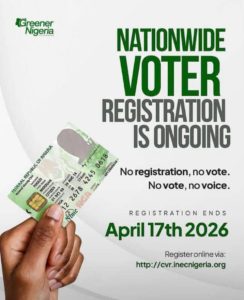

As Nigeria approaches another critical phase in its democratic journey, a quiet but consequential process is underway, one that will determine who gets to participate in shaping the nation’s future. The ongoing Continuous Voter Registration (CVR) exercise, supervised by the Independent National Electoral Commission (INEC), is scheduled to close on April 17, 2026. Yet, despite its significance, awareness remains worryingly low.
The implications are clear. Nigerians who fail to register before the deadline will be unable to vote in upcoming elections. In a democracy, that effectively means forfeiting one’s voice. That means you have decided to keep quiet when the matters of your life are being decoded.
Across Nigeria, and elsewhere in the world, elections are more than routine civic exercises. They are defining moments that shape governance, policy direction, and national priorities. At the centre of this process is the individual voter. Many would have thought the politicians are the centre of the showpiece, but it is you, the the citizen, the voter. Civil participation, particularly through voting, remains one of the most powerful tools citizens possess to influence leadership and demand accountability.
However, this power begins with a simple but essential step. Registration.
The Gateway to Participation
Voter registration is the foundation of electoral participation. Without being captured in the national voter database, no citizen, regardless of interest or eligibility, can cast a ballot. The CVR exercise exists to ensure that all eligible Nigerians have the opportunity to be included.
Registration confers official recognition as a voter, assigns individuals to polling units, and ultimately enables the issuance of the Permanent Voter Card (PVC), which is mandatory on election day.
The message is as starik as it is true. No registration, no vote. No vote, no voice.
Who Should Take Action?
The CVR exercise caters to a broad spectrum of Nigerians.
First are new voters, citizens who have recently turned 18 and are now eligible to vote. For many, this marks their first opportunity to participate in the democratic process.
Second are those who, for various reasons, missed previous registration exercises. The current window offers another chance to be included.
There are also registered voters who need to update their details. This includes individuals who have relocated and wish to transfer their polling units to areas closer to their new residences, whether within cities like Abuja or across state lines.
Additionally, voters who have lost or damaged their PVCs can apply for replacements, while others may seek to correct personal information such as names or dates of birth.
All of these come at no personal financial cost to the citizen. The government has taken care of it.
According to INEC,
Understanding the Process
INEC has streamlined the registration process to improve accessibility and efficiency.
The first step is online pre-registration via the official CVR portal at https://cvr.inecnigeria.org. Here, applicants provide their basic details. While this step reduces waiting time, it does not complete the process. But it is an essential one you can do right on your phone, right now.
Applicants must then visit a designated INEC registration centre for physical capture, during which biometric data, fingerprints and facial images, are recorded. This stage is compulsory.
Upon completion, registrants receive an acknowledgment slip, which serves as proof of registration and is required for the collection of the PVC once it is ready.
For general information, updates, and verified announcements, Nigerians can also visit the INEC website at https://www.inecnigeria.org or follow official communication channels.
Addressing Mobility Through Polling Unit Transfer
In a country with a highly mobile population, the ability to transfer polling units is essential. Nigerians who have changed their place of residence can apply to vote in locations closer to them, ensuring that distance does not become a barrier to participation. Some people have recently moved to areas like Kubwa can easily transfer their poling unit to somewhere closer to where they live, so that on election day, they are less stressed walking to the unit to cast their votes, as vehicular movement will be restricted.
The process involves submitting a transfer request through the CVR portal or at a registration centre, providing existing voter details, and completing verification procedures where necessary. This flexibility is crucial in preserving the inclusiveness of the electoral system.
You can click here to know your polling unit.
If you want to know how far your polling unit is to your residence,you can click here to get directions.
The Cost of Apathy
With the April 17 deadline fast approaching, the urgency cannot be overstated. Low awareness levels risk leaving millions of eligible Nigerians outside the electoral process.
Democracy thrives not merely on the existence of institutions, but on active citizen engagement. Registration is the entry point. Participation is the goal.
Beyond registration, meaningful civic involvement requires staying informed, engaging in public discourse, and ultimately turning out to vote.
A Defining Moment
As the clock ticks down, the responsibility lies with citizens to act and to encourage others to do the same. Informed Nigerians must become advocates, ensuring that family members, friends, and communities are aware of the opportunity and the deadline. Just as you have become aware now, even you have your voter’s card and you have nothing to change, it is still important you help share the information within your circle of influence.
Clergy men should use the opportunity of addressing congregations to propagate the message. Parents should encourage their children who have come of age. Everyone of us should be involved in the process.
The strength of Nigeria’s democracy depends on the breadth of participation it commands. Every registered voter represents a voice counted, a perspective acknowledged, and a stake in the nation’s future.
The choice, ultimately, is simple. To participate or to be absent.

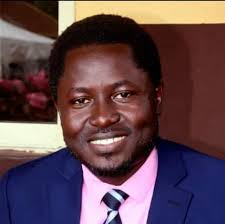
Oluwaseyi Ige
Oluwaseyi Ige is a media consultant, communication strategist, and the Chief Operating Officer of
Jabbok Media Services.
An associate pastor at TBC Kubwa and a youth missionary, he previously served as the Media and Communications Coordinator
for Youth for Christ (YFC) Nigeria. He is the founder of Quantum of Grace, an outreach ministry, and the author of
Still Becoming and
Digital Loneliness.
His latest work, Becoming You, is a personal guide helping the next generation navigate the identity fight
and build a life of impact. You can catch up with him on
radio.