
Kubwa News
Lowest House Rent in Kubwa


Having decent accommodation should not cost so much for any modern city dweller, but that assumption is not correct.
Renting an apartment for 12 months in a good location here in Abuja is not done with a smile on the face. It is a necessity that demands a steady, predictable, high income. High, steady, predictable income, not a windfall.
Professionals and public service employees top the category of persons who mostly need at least a two-bedroom apartment in a “decent” place.
The way the FCT develops makes it so that every resident would prefer to live close to their place of work, which has long been clustered in the “town” of Abuja–Maitama, Asokoro and Central Business District.
Historically, civil servants who were moved from Lagos to Abuja lived in places such as Minister’s Hill, Garki Areas and Wuse Zones. But the rapid changes in civil service dynamics and the completion of housing projects in satellite towns such as Jikwoyi, Lugbe and of course, Kubwa in the middle of the 1990s compelled civil service staff to move to allocated accommodation in the newly developed town.
What then followed in the early 2000s was that “Town” immediately became elitist. Those accommodations were then reserved for staff in the executive cadre, and proximity to government offices and recreational spots immediately made available properties to skyrocket in price.
Meanwhile, people were coming into Abuja in great number everyday, especially from 1999. The influx was so much that finding accommodation became a crisis. Kubwa became a maze of some sort because of a free-for-all approach to housing development. Houses were built under high tension electricity cables in Gbazango and everywhere under the cable. Places like 2-1 and PW markets were an overcrowded residential communities. This was the primary reason for the explosion of what were essentially illegal buildings and structures, which were later demolished by Mallam Nasir El-Rufai, the Minister of the Federal Capital Territory.
But today, real estate business or what may be termed an industry has long been established and is booming even here in Kubwa beacuse private businesses and their workforce also need accommodation. This high demand is what drives up rent prices relative to location all around Abuja.
According to Abuja Plug (X: @ABUJAPLUG), renting a 1 bedroom apartment in Abuja in March 2026, ranges between N 5 million and N 800,000.
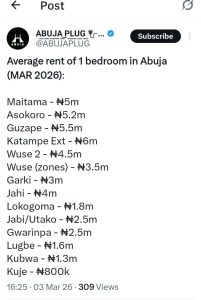
Abuja Plug on X
Looking at the screenshort above, it becomes evident that Kubwa offers a very affordable rental demand for any seeker.
In a brief chat with Blessed an Estate Agent in Kubwa, he revealed that a 1 bedroom apartment in Arab Road area of Kubwa is between N 1.8 to 2.5 million and one may be lucky to have a deal for N 1.3 million in 2-1 as is the case with one he is currrently marketing.
So here we see that in terms of “affordable” accommodation, Kubwa is doing very well for Abuja residents based on available amenities and proximity to “Town”.



-
 Kubwa News5 months ago
KUBWA ARAB ROAD LIKE YOU’VE NEVER SEEN BEFORE!
-

 Politics7 months ago
BWARI AREA COUNCIL ELECTION SERIES: HON. SOLOMON DANJUMA GARDA
-

 Business5 months ago
THE OBJECT CALLED WOMAN
-

 Entertainment7 months ago
Mind Your Mind
-

 Politics7 months ago
BWARI AREA COUNCIL ELECTION SERIES: HON. JOSIAH MUSA KOCHE
-

 FCT News8 months ago
WATER DISRUPTION UPDATE
-
FCT News8 months ago
FCT WATER BOARD EXCLUSIVE! WHY YOU ARE NOT BILLED
-

 Fashion8 months ago
Happy Birthday to one of Kubwa’s finest nail artists – Mrs Oge U. Ekenna